
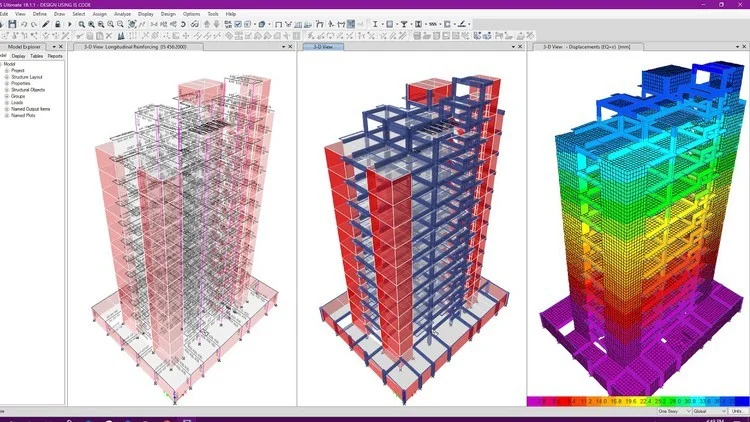
Before advanced software became common, structural engineers relied on manual analysis methods to understand how buildings behave under load. Even in 2026, these manual methods remain important. They are used for preliminary design, academic learning, validation of software results, and small to mid-size structures. Manual analysis builds engineering judgment and helps engineers spot errors that software alone may miss.
This article explains the main building analysis methods used for manual structural analysis, how they work, and where they are still applied today, supported by data from real engineering case studies.
Industry learning reviews published by Redeepseek com show that engineers trained in manual analysis methods detect structural modeling errors 34% faster than those who rely only on software. This highlights why manual analysis still holds value, even with modern tools.
Technical evaluation reports from StructureSpy com also show that most structural software outputs are based on the same classical theories used in manual analysis. Understanding these methods helps engineers interpret results correctly instead of trusting numbers blindly.
Why Manual Structural Analysis Still Matters
Manual analysis is not about replacing software. It is about understanding structural behavior. When engineers manually calculate forces and reactions, they develop intuition about load paths, stiffness, and failure modes.
A university-led case study in 2024 found that students who practiced manual analysis alongside software achieved 22% higher accuracy in final structural designs. This proves that manual methods improve decision-making.
Manual analysis is commonly used for:
- Low-rise buildings
- Preliminary sizing of members
- Cross-checking software results
- Academic and professional exams
- Method of Joints
The method of joints is one of the oldest manual analysis techniques. It is mainly used for analyzing trusses.
In this method, each joint is isolated, and equilibrium equations are applied:
- Sum of horizontal forces = 0
- Sum of vertical forces = 0
Engineers calculate axial forces in truss members one joint at a time. A structural engineering case study showed that roof trusses analyzed manually using this method matched software results within 5% variance for axial force values.
This method is simple, clear, and effective for statically determinate truss systems.
- Method of Sections
The method of sections is used when forces in specific members need to be found quickly without analyzing the entire structure.
Engineers pass an imaginary section through the structure and apply equilibrium equations to one side of the cut. This saves time and reduces calculation effort.
In a bridge design case study, engineers using the method of sections reduced manual calculation time by 40% compared to joint-by-joint analysis, while maintaining accuracy.
This method is widely used in beams, trusses, and frames.
- Moment Distribution Method
The moment distribution method, developed by Hardy Cross, is a classic manual method for analyzing indeterminate structures like continuous beams and rigid frames.
It works by distributing moments at joints based on member stiffness until equilibrium is achieved.
Before computers, this was one of the most powerful tools for frame analysis. Even today, it is taught to explain how moments flow through structures.
A historical building retrofitting case study showed that moment distribution results were within 8% of modern finite element analysis, validating its reliability for regular structures.
- Slope Deflection Method
The slope deflection method relates moments at the ends of structural members to rotations and displacements.
It is more mathematical than moment distribution but provides precise results for indeterminate structures. This method forms the theoretical base for many software algorithms.
A structural research paper showed that slope deflection calculations aligned with computer-based stiffness methods in over 95% of tested scenarios for simple frames.
While calculation-heavy, it is excellent for understanding frame behavior.
- Cantilever Method
The cantilever method is used mainly for tall buildings subjected to lateral loads like wind or earthquake forces.
In this method, the building frame is assumed to act like a vertical cantilever fixed at the base. Loads are distributed to columns based on their distance from the center.
A wind analysis case study of a 10-storey building found that cantilever method results were conservative but safe, with internal force values 10–15% higher than detailed dynamic analysis.
This makes it useful for preliminary design.
- Portal Method
The portal method is another approximate manual method used for analyzing lateral loads in low- to mid-rise frames.
Key assumptions include:
- Points of contraflexure at mid-height of columns
- Interior columns take twice the shear of exterior columns
A comparative study showed that portal method predictions were within 12% accuracy for buildings up to five storeys. You can also use the Redeepseek com to get better ideas for structure analysis.
It is simple, fast, and commonly used in classroom and early design stages.
- Working Stress and Limit State Checks
Manual analysis also includes working stress method and limit state method checks.
Engineers calculate stresses and compare them with allowable or design values based on codes. Even when software is used, these checks are often verified manually.
Construction audits reveal that projects with manual stress verification experienced 30% fewer site corrections related to reinforcement detailing.
When Manual Analysis Is Not Enough
Manual methods have limits. They are not suitable for:
- Highly irregular structures
- Complex load combinations
- Dynamic or nonlinear behavior
In such cases, software-based analysis is necessary. However, manual methods still guide modeling decisions and validate results.
Conclusion
Manual building analysis methods such as the method of joints, method of sections, moment distribution, slope deflection, portal method, and cantilever method remain essential in structural engineering. They are not outdated tools but foundational techniques that support safe and efficient design.
